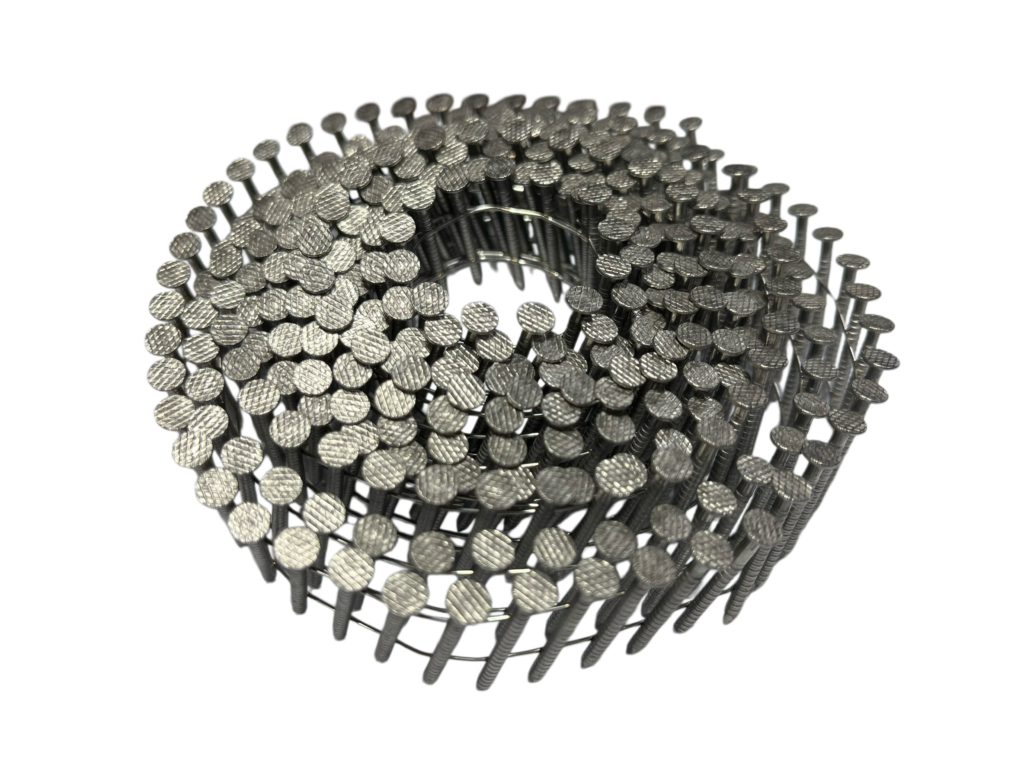
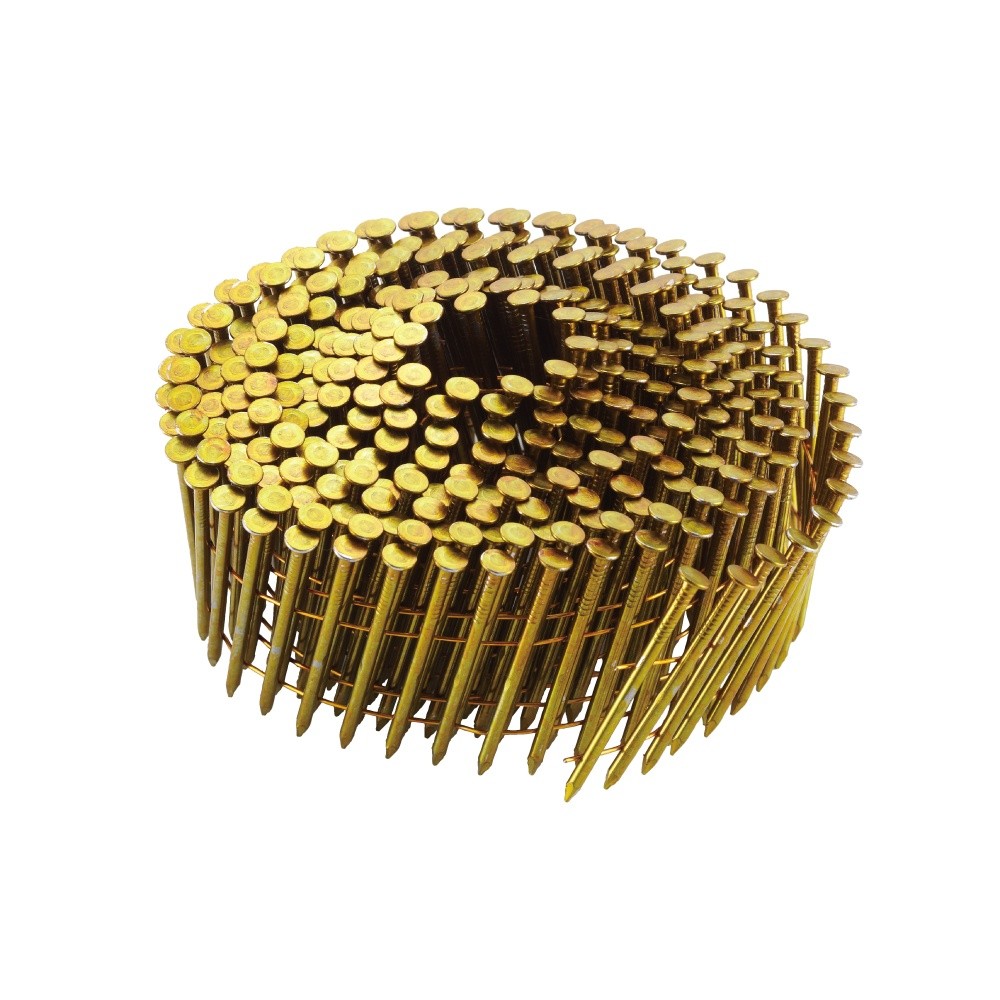
Coil nails, also known as coil nails or round nail coils, are nails arranged in coils specifically designed for pneumatic coil nail guns. The core feature is that individual straight nails are fixed into a continuous coil shape with glue or solder, which greatly improves nailing efficiency. They are one of the mainstream fasteners in wooden pallets, wooden boxes, and wood structure operations. In terms of material, high-quality high-carbon steel wire is mainly used. For those with high anti-corrosion requirements, stainless steel is adopted. The surface is generally treated with electroplating or hot-dip galvanizing, with a uniform and dense coating that has strong rust resistance, preventing rust from contaminating wood or affecting structural strength. For special scenarios, rust-proof processes such as copper plating and Dacromet are also available. The nails themselves undergo quenching and tempering, achieving a good balance between hardness and toughness. They are not easy to bend or break during nailing, not prone to causing wood splitting when penetrating, and have stable gripping force after being driven in, which is not easy to loosen or fall off. In terms of specifications, the core parameters of coil nails are the diameter and length of the nail body. The common diameter ranges from 2.1mm to 4.6mm, corresponding to different load-bearing and penetration requirements; the nail length covers the range from 25mm to 130mm, which can adapt to various scenarios from light thin plate fixing to heavy wood structure connection. The nail type is mainly ordinary smooth rod round nails, and there are also anti-slip ones with spiral or ring patterns on the nail body. The nail tip is designed with a conical or rhombic sharp angle, which has strong penetration, feeds smoothly into the gun, and is not easy to jam. In terms of arrangement, the nails are coiled in a spiral shape at equal intervals. The number of nails per coil varies from 100 to 300 depending on the specifications. The connection methods are divided into gluing and welding. The glued type is more suitable for high-speed gun models, while the welded type has higher connection strength and is suitable for heavy-duty operations. In terms of adaptability, coil nails correspond to different diameters and lengths, matching special pneumatic coil nail guns. There are corresponding specifications from light 32mm small coil nail guns to heavy 130mm large coil nail guns. During operation, continuous nailing can be performed without frequent nail loading, and the efficiency is much higher than that of bulk straight nails. They are widely used in scenarios such as the assembly and fixing of wooden pallets, wooden boxes, and wooden frames. They are also commonly used fasteners in industries such as wooden house construction, wood structure building, furniture manufacturing, and packaging reinforcement. They are especially suitable for mass production assembly line operations, which can significantly reduce labor costs and improve operational stability.